
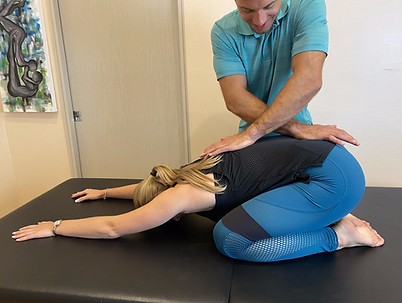
Manual Therapy/Bodywork
Your ‘hands-on’ experience includes a combination of techniques where your physical therapist will use his/her hands to feel for tension and dysfunction through different layers of your muscles and fascia. We are able to quickly identify dysfunction in areas of your body that require physical mobilization in order to restore proper function.
Common dysfunctions that are treated with manual therapy include: hypertonicity, trigger points, joint hypomobility, joint instability/hypermobility, myofascial ‘knots’, ‘stuck’ nerves, poor activation of certain muscle groups.

Craniosacral Therapy
Craniosacral Therapy (CST) is a gentle, hands-on form of manual therapy that focuses on evaluating and enhancing function in the craniosacral system of the body.
The craniosacral system is made up of membranes and cerebrospinal fluid that surrounds and protects your brain and spinal cord. With CST, a physical therapist uses gentle pressure to mobilize the skull & spine, and release unwanted tension that imposes regulation of the flow of cerebrospinal fluid (CSF). By improving the production and flow of CSF your body is better able to cleanse harmful toxins from your spinal cord and brain - which enhances the body’s natural ability to heal and self-correct.

Trigger Point Release
Trigger point release (TPR) entails direct pressure to an identified dysfunctional point in the body. Typically it is a muscle ‘knot’ commonly known as a trigger point. TPR can sometimes reproduce pain that you might feel with your dysfunctional/painful movements, often in a place different from where the trigger point is actually located. For example, a trigger point on the back of your shoulder can reproduce pain in your elbow, or a trigger point on the outside of your hip may reproduce pain in your knee.
We then teach you how to perform a similar release on your own usually using a ball or small tool, this way you can continue to improve yourself everyday!
We also perform releases on the visceral organs, including diaphragm, stomach, bladder, uterus, intestines, etc. There are often fascial restrictions that cause visceral organs to stick in place, or glue themselves to the visceral wall or a deep muscle. When this occurs it creates issues, delayed healing, and pain in other parts of the body that otherwise seem unrelated.
These techniques significantly relieve menstrual pains, incontinence, and constipation- often better than medications .

Functional Mobilizations
Functional mobilizations are a hands on technique that pinpoint restrictions in either your muscle, fascia, or joints/bones, and use active movement by the patient along with precise pressure to release the restriction and immediately improve movement. This is a full body approach, recognizing that every part of the body is intricately interconnected and that efficient movement requires dynamic interaction between mechanical, neuromuscular, and motor control systems.

Myofascial Release
Every muscle fiber in your body is surrounded in a connective tissue called myofascia (fascia also surrounds organs other than muscle). Healthy myofascia acts as support and lubricant for your muscles. Myofascia can become dysfunctional and act like glue which causes stiffness or achiness.
Myofascial release is a simple hands on technique that frees up the fascia from the muscle fibers to restore hydration and movement. It works best skin-on-skin, and typically involves superficial touch (as opposed to deeper layers) where the direction of greatest restriction is found and the skin is effectively gently pushed in that direction. Releasing fascia in one area of the body often creates improved movement and a feeling of openness in other parts of your body.